
What do the treatments behind “glass skin” in Korea actually do?
Glass skin is a search phrase, not a treatment or a promised result. The treatments people group under it do different jobs: Rejuran is a skin booster injection, Potenza is microneedle radiofrequency, toning lasers target pigment, redness lasers work on dilated vessels, and Thermage FLX, Ultherapy Prime and XERF are lifting devices. A dermatologist decides which fit.
- Skin booster
- Rejuran: PN from salmon DNA, with hyaluronic acid
- Microneedling RF
- Potenza: needles deliver RF heat energy
- Pigment lasers
- Hollywood Spectra (Q-Switched Nd:YAG), PicoPlus (picosecond)
- Redness options
- Clarity II (755nm and 1064nm), LDM
- Thermage FLX
- Radiofrequency · face and neck
- Ultherapy Prime
- Ultrasound · face and chin
- XERF
- Two radiofrequencies, 6.78MHz and 2MHz
- Skin analysis device
- Mirage 3D
Glass skin is what people type into a search bar
Glass skin describes a look. No device is designed to produce it and no treatment can promise it, so this page does not. What it does is take the treatments that usually come up under that search and explain, from AUVEL Clinic's own treatment pages, what each one is actually for.
They are not interchangeable and they are not ranked here. Some work on texture, some on pigment, some on vessels, some on firmness. Which of them applies to you depends on what your skin is doing.
Skin boosters: Rejuran
Rejuran is an injection. The clinic's filler and Rejuran page describes its main ingredient as PN, derived from salmon DNA, which activates the skin's self-regeneration to improve elasticity, wrinkles and hydration. Hyaluronic acid is added for moisture.
The English price list carries two versions, Rejuran Healer and Rejuran HB / I, and notes that Rejuran is not available in the US. That is one reason it comes up so often in searches from abroad.
Microneedling RF: Potenza
Potenza inserts fine needles into the skin and delivers radiofrequency heat energy through them. The equipment page describes it as helping to improve texture and elasticity.
It is listed for pores, scars, acne, pigmentation and fine lines, and appears on the clinic's Scar, Acne and Pores pages. On the Pores page, enlarged pores are described as the combined result of excess sebum, impaired sebum drainage and collagen loss with age.
Toning lasers: the pigment side
Toning is a way of using a laser rather than a single machine. The lasers behind it on the Pigmentation page are chosen after the pigment has been diagnosed, because what looks like one brown mark can be several different conditions.
- Hollywood Spectra: Q-Switched Nd:YAG, for various pigment concerns, acne and anti-aging
- PicoPlus: picosecond pulses, for blemishes and tattoo removal
- Also on the Pigmentation page: Clarity II, N-Pulse, LOTUS3, AGNES and skin boosters
Redness lasers: the vessel side
Redness is a different problem from pigment. The Redness page describes skin that flushes as blood vessels dilate, mainly on the cheeks, nose and forehead, and says vascular laser treatment and soothing care can help improve it.
- Clarity II: long-pulsed 755nm and 1064nm, listed for pigment, hair removal and vascular treatment
- LDM: ultrasound energy for soothing, hydration and barrier care
Lifting devices: Thermage FLX, Ultherapy Prime, XERF
These three work on firmness rather than surface tone, and they use different energy. None of them is described as a glass skin treatment on its own page; they are included here because they come up under the same search.
- Thermage FLX: radiofrequency heat into the dermis for elasticity and fine lines, on the face and neck; the page lists onset within two weeks
- Ultherapy Prime: ultrasound energy delivered into deeper layers, on the face and chin; the page lists onset within four weeks
- XERF: alternates two radiofrequencies (6.78MHz and 2MHz) through a 6cm² tip; the page lists onset within two weeks
How the choice gets made
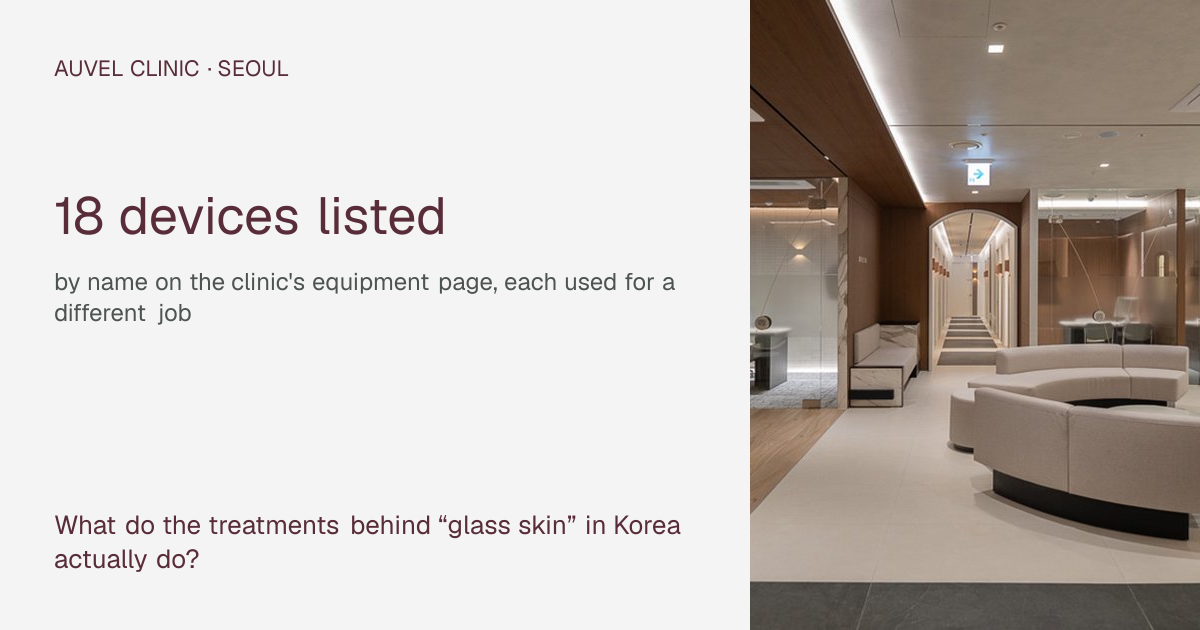
The clinic lists eighteen devices by name on its equipment page, and one of them, Mirage 3D, is a 3D skin-analysis device used to assess skin condition and plan treatments. Having that many options only helps if someone decides between them.
That decision belongs to a board-certified dermatologist. Both of the clinic's doctors, Dr. Ko Young-wook and Dr. Song Chang-hwa, completed their dermatology residency at Hanyang University Hospital.
Visiting
AUVEL Clinic is at 12F, 138 Dosan-daero, Gangnam-gu, one minute from Sinsa Station Exit 1. English questions go to WhatsApp at +82 10-5924-4401.
Frequently asked questions
Is there a single glass skin treatment in Korea?
No. Glass skin is a search phrase. The treatments grouped under it do different jobs: boosters, microneedling RF, pigment lasers, redness lasers and lifting devices.
What does Rejuran do?
It is an injection whose PN ingredient, derived from salmon DNA, activates the skin's self-regeneration to improve elasticity, wrinkles and hydration, with hyaluronic acid added.
Is toning the same as a redness laser?
No. Toning lasers on the clinic's Pigmentation page target pigment. Redness options such as Clarity II and LDM are listed for dilated vessels and sensitive skin.
How are Thermage FLX, Ultherapy Prime and XERF different?
Thermage FLX uses radiofrequency, Ultherapy Prime uses ultrasound delivered to deeper layers, and XERF alternates two radiofrequencies. The clinic does not rank them.
Can I get all of these on one trip?
That depends on what your skin needs and is decided by a dermatologist at the consultation. Ask over WhatsApp before booking if you are planning a trip around it.