
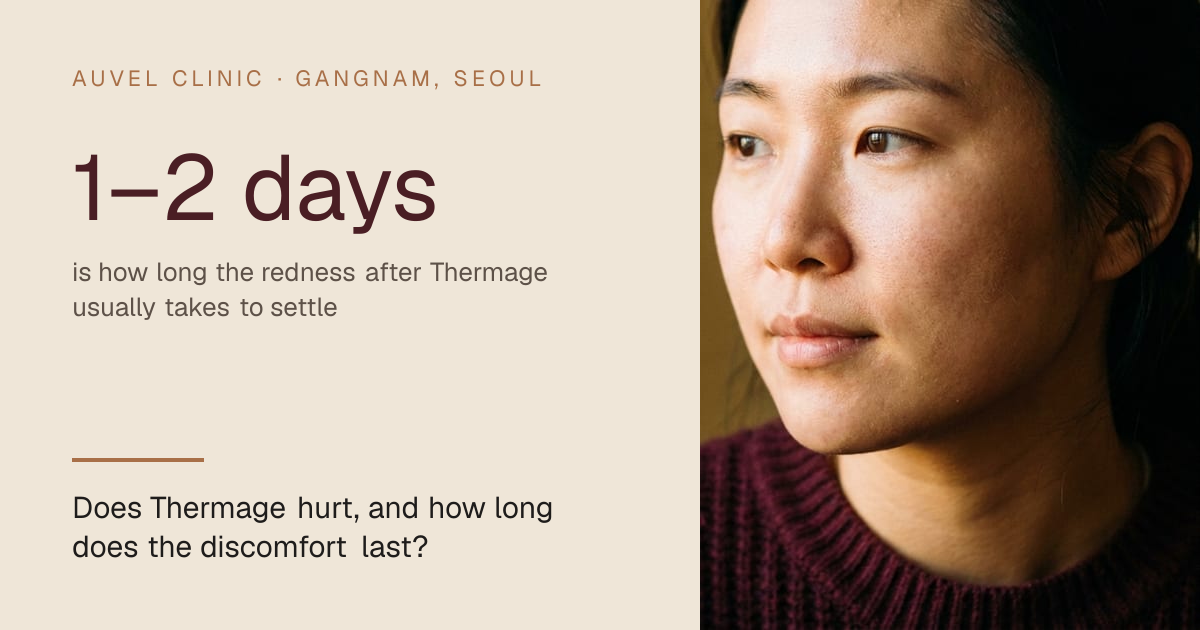
Does Thermage hurt, and how long does the discomfort last?
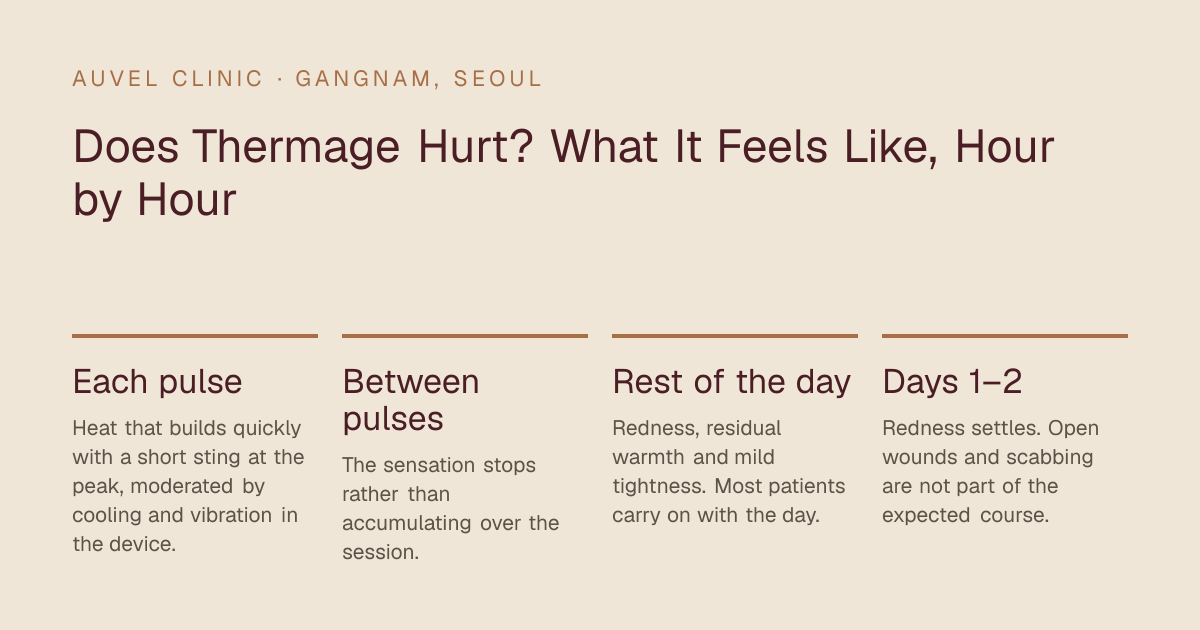
Thermage is felt. Each pulse delivers warmth with a brief sting, moderated by cooling and vibration built into the device. The sensation ends with the pulse rather than continuing afterwards. Redness and residual warmth are normal and usually settle within one to two days, and the treatment is not designed to leave open wounds or scabbing.
- During each pulse
- Warmth with a brief sting
- Between pulses
- Sensation stops; it does not build up
- Felt most
- Close to bone, and on thinner skin
- Built into the device
- Cooling and vibration
- Straight after
- Redness, residual warmth, mild tightness
- Redness settles
- Usually within 1–2 days
- Not expected
- Open wounds or scabbing
- Postpone for a few days
- Sauna, hot baths, vigorous exercise
What one pulse feels like
The tip is placed against the skin and a pulse of radiofrequency energy is delivered. What you register is heat that builds quickly and a short sting at the peak of it. Then it stops. The tip moves, and the next pulse begins.
Two things reduce that sensation, and both are part of the device rather than something added afterwards: the surface is cooled at the same moment the energy goes in, and the handpiece vibrates. Vibration works because the nerves carrying touch reach the brain ahead of the ones carrying the sting. It's the same reason rubbing a bumped elbow helps.
The important characteristic is that the sensation does not accumulate. It ends with each pulse rather than building over the session, which is why patients describe the treatment as a sequence of brief moments rather than as sustained pain.
Why some parts of the face feel it more
The forehead, the jaw and the area around the eyes tend to register more clearly than the cheeks. Where skin sits directly over bone there is less soft tissue between the energy and the nerve endings, and thinner skin reacts more readily than thick skin.
This is also why the plan is mapped per area rather than delivered uniformly. The amount and depth of energy is set by what each part of the face can take, and telling the doctor during the session that one area is sharper than the rest is useful information, not a complaint.
People differ considerably here. Sensitivity is individual, and the same setting is not experienced identically by two patients.
The rest of the day
Immediately afterwards the skin is usually red and feels warm, a little like mild sun exposure, and often slightly tighter. That early tightness is a sensation, not the result. The visible change from collagen remodeling comes months later.
Most people go back to their day directly. Makeup, travel and normal activity are not typically restricted, though the skin can be more reactive than usual until the following morning.
Redness and warmth generally settle within one to two days. The treatment is not intended to break the skin surface, so scabbing and open wounds are not part of the expected course.
The first week
There is no enforced recovery period, but a few habits are worth adjusting briefly. Heat is the main one: anything that raises skin temperature substantially is better postponed while the skin settles.
Sun protection matters for longer than the redness does. Collagen remodeling continues quietly for months, and consistent protection over that period is part of the plan rather than an afterthought.
- Skip saunas, jjimjilbang and hot baths for a few days
- Leave vigorous exercise for a few days as well
- Moisturize more attentively than your usual routine
- Use sun protection consistently, not only in the first week
- Contact the clinic if redness worsens after the second day, or if blistering or persistent pain appears
Planning the session while you are in Seoul
Because there is no scheduled downtime, the session itself fits into a travel day without much rearranging. The result is another matter. It develops over months, so keep that in mind before you book around your flights.
AUVEL Clinic is on the 12th floor at 138 Dosan-daero in Gangnam-gu, Seoul, one minute from Sinsa Station Exit 1, and the device used here is Thermage FLX. Weekday appointments run until 8:00 PM.
International credit cards are accepted. English questions are handled over WhatsApp, including after you have flown home and want to ask whether something you are seeing is normal.
- Address: 12F, 138 Dosan-daero, Gangnam-gu, Seoul, 1 minute from Sinsa Station Exit 1
- Hours: Weekdays 10:00 AM – 8:00 PM · Saturday 10:00 AM – 4:00 PM · Lunch 1:00 PM – 2:00 PM
- Closed on Sundays and public holidays · Valet parking available in the building
- English questions and booking: WhatsApp +82 10-5924-4401 · Clinic line +82 2-548-5007
Frequently asked questions
Does Thermage hurt?
It is felt. Each pulse delivers warmth with a brief sting, reduced by cooling and vibration built into the device. The sensation ends with the pulse rather than continuing, so the session is experienced as a series of brief moments rather than sustained pain.
Is numbing cream used?
How each session is prepared is decided at the clinic based on the areas being treated and your own sensitivity. Ask about it at the consultation. Patients ask this all the time, and it's better settled before you're on the treatment bed.
How long does the redness last?
Redness and residual warmth usually settle within one to two days. If redness worsens after the second day, or if blistering or persistent pain appears, contact the clinic rather than waiting.
Can I wear makeup afterwards?
The treatment is not intended to break the skin surface, and most patients return to normal activity the same day. The skin can be more reactive than usual until the next morning, so gentler handling for the rest of the day is sensible.
How soon can I go to a sauna or jjimjilbang?
Leave it for a few days, along with hot baths and vigorous exercise. Anything that raises skin temperature substantially is better postponed while the skin settles.
Which areas of the face feel it most?
Areas where skin sits close to bone, such as the forehead and jaw, and areas where the skin is thinner tend to register more clearly than the cheeks. Sensitivity also varies considerably between individuals.