
How much downtime should I plan for after laser toning?
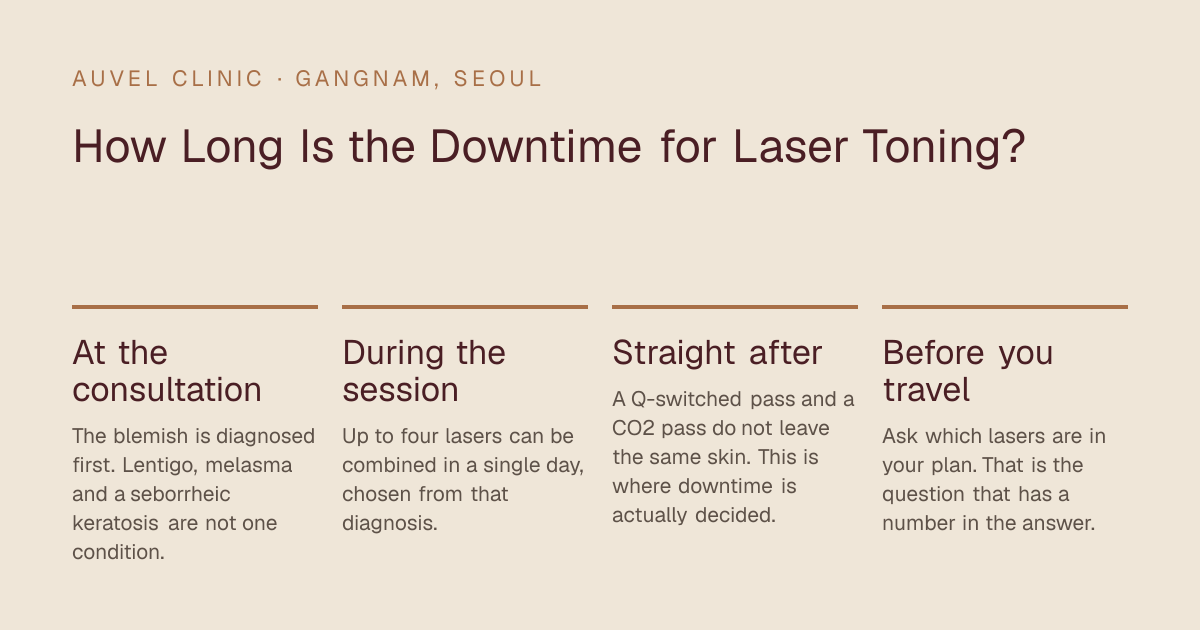
There is no single answer, because laser toning names a technique rather than one machine. At AUVEL Clinic pigment concerns are diagnosed first and then treated with a combination of lasers, and a Q-switched pass and a CO2 pass do not leave the same skin at the end of the day. Ask which lasers are in your own plan. That answer sets your downtime, not the word toning.
- What the word names
- A technique, not a single machine
- Program
- AUVEL's signature one-day blemish removal, combining four lasers
- Diagnosed by
- Board-certified dermatologists
- Q-switched laser
- Hollywood Spectra (Q-Switched Nd:YAG)
- Picosecond laser
- PicoPlus: pulses about 100 times faster than nanosecond lasers
- CO2 laser
- N-Pulse: removes blemishes directly with thermal energy
- Conditions covered
- Lentigo, freckles, melasma, moles, seborrheic keratosis, warts, milia, flat warts and more
- What sets your downtime
- Which lasers are in your plan, not the word toning
Why the question has no fixed number
Laser toning is one of those terms that travels further than its definition. It describes a way of using a laser: low energy in repeated passes, spread across the skin rather than aimed at one spot. Several different machines can be used that way. It is not the name of a device, and it is not the name of a single appointment.
That is why a number quoted on one clinic's page does not transfer to another. Two patients can both be told they are having laser toning and leave with completely different instructions, because the rest of what happened in the room was different.
So the useful question is not how long laser toning takes to heal. It is what is actually in your session.
What is actually in the room
At AUVEL Clinic, pigment and blemish concerns are treated through a program that combines four lasers to address them in one day, after a board-certified dermatologist has diagnosed what the marks are. The diagnosis comes first for a reason: a lentigo, a melasma patch, a seborrheic keratosis and a flat wart look similar enough to a patient and behave nothing alike under a laser.
The devices behind that program are not interchangeable. Hollywood Spectra uses Q-Switched Nd:YAG technology and is used across pigment concerns, acne and anti-aging work. PicoPlus fires in picosecond pulses, roughly a hundred times faster than nanosecond lasers, and is used for blemishes and tattoo removal. N-Pulse is a CO2 laser that removes blemishes directly with thermal energy.
Read those three descriptions again and the answer to the downtime question becomes obvious. A laser that spreads low energy across the skin and a laser that removes a lesion outright are not going to leave you in the same state at 6 PM.
- Hollywood Spectra (Q-Switched Nd:YAG), used across pigment, acne and anti-aging
- PicoPlus: picosecond pulses, about 100 times faster than nanosecond lasers
- N-Pulse: CO2, removes blemishes directly with thermal energy
- Clarity II, LOTUS3, AGNES and skin boosters are also part of the wider program
The list we are not going to publish
We could put a table here with three days for this and seven for that. We won't, because we would be making it up. The recovery that follows a session belongs to that session, and the instructions are written by the doctor who planned it.
What we can tell you is where the number comes from. If your plan is built around Q-switched and picosecond passes, you are in one conversation. If a CO2 laser is being used to remove something, you are in another one, and the treated spot needs looking after until it has healed.
Asking which lasers are in your plan is not a technical question and you do not need to know anything about lasers to ask it. It is the one question that turns a vague answer into a specific one.
- Ask which lasers are planned for your session
- Ask whether anything is being removed rather than lightened
- Ask for your own aftercare instructions in writing before you leave
If you are flying in for it
The program is built to address blemishes in one day, which is what makes it workable for a trip. The part that needs planning is not the appointment length but the days after it, and those depend on the plan rather than the calendar.
The practical approach is to have the consultation before you commit to your return flight, not after. Once the diagnosis is made and the lasers are chosen, the clinic can tell you what your own days look like, and that answer will be about your skin rather than about an average.
Pigment concerns are also rarely settled in a single visit for everyone. Whether yours needs more than one session is part of the same conversation, and it is better to hear it at the start of a trip than at the end.
Where to ask
AUVEL Clinic is on the 12th floor at 138 Dosan-daero in Gangnam-gu, Seoul, one minute from Sinsa Station Exit 1. Weekday appointments run until 8:00 PM and Saturday appointments until 4:00 PM.
International credit cards are accepted. English questions are handled over WhatsApp, before and after your visit.
- Address: 12F, 138 Dosan-daero, Gangnam-gu, Seoul, 1 minute from Sinsa Station Exit 1
- Hours: Weekdays 10:00 AM – 8:00 PM · Saturday 10:00 AM – 4:00 PM · Lunch 1:00 PM – 2:00 PM
- Closed on Sundays and public holidays · Valet parking available in the building
- English questions and booking: WhatsApp +82 10-5924-4401 · Clinic line +82 2-548-5007
Frequently asked questions
How long is the downtime for laser toning?
There is no single number, because laser toning names a technique rather than one device. What decides your own recovery is which lasers are used in your session. A Q-switched or picosecond pass leaves very different skin than a CO2 pass. Ask which lasers are in your plan at the consultation.
Is laser toning one machine?
No. It describes a way of using a laser, with low energy spread across the skin in repeated passes, and several devices can be used that way. At AUVEL Clinic the blemish program combines four lasers chosen from the diagnosis.
Which lasers does AUVEL Clinic use for pigmentation?
The program draws on Hollywood Spectra (Q-Switched Nd:YAG), PicoPlus (picosecond), N-Pulse (CO2), Clarity II, LOTUS3, AGNES and skin boosters. Which of them applies is decided after a board-certified dermatologist diagnoses the blemish.
Can pigmentation be treated in one day?
The program is built to address blemishes in one day by combining lasers rather than spreading them across separate visits. Whether your own concern is settled in one session is part of the diagnosis.
Why will you not publish a recovery table?
Because the recovery belongs to the session, not to the word. A table that averages very different lasers into one number reads as precise and is not. Your own instructions are given by the doctor who planned your treatment.
Should I book the consultation before my return flight?
Yes. Once the diagnosis is made and the lasers are chosen, the clinic can tell you what your own days look like. Booking the flight first means fitting your skin around a ticket.